


In order to prevent the occurrence of cable fire accidents, the following preventive measures should be taken:
(1) Choose cables that meet thermal stability requirements. The selected cable, under normal conditions, can meet the heating requirements of the long-term rated load, and under short-circuit conditions, it can meet the short-term thermal stability and avoid the cable from overheating and igniting.
(2) Prevent running overload. When the cable is running under load, it generally does not exceed the rated load. If it is overloaded, the overload running time of the cable should be strictly controlled to avoid overloading and heating the cable to catch fire.
(3) Observe the relevant regulations for cable laying. Cables should be laid as far away as possible from the heat source and avoid parallel or cross arrangement with steam pipes. If they are parallel or crossed, the specified distance should be kept and heat insulation measures should be taken. It is forbidden to lay the cables in parallel above or below the hot pipes; in some pipes Generally avoid laying cables in tunnels or trenches. If laying is necessary, heat insulation measures should be taken; cables laid overhead, especially plastic and rubber cables, should have heat insulation measures to prevent thermal influences such as heat pipes; when laying cables, The parallel or crossing distances between cables, between cables and heating pipes and other pipes, between cables and roads, railways, buildings, etc. should meet the regulations; in addition, the cable laying should be left with a waveform margin to prevent winter The cable stops running and shrinks to produce excessive tension and damage the cable insulation. The minimum curvature radius of the cable should be ensured to prevent excessive bending and damage the cable insulation; joints should be avoided in the cable tunnel, because the cable joint is the weakest place in the cable insulation, the joint is prone to short-circuit failure of the cable, when it must be in the tunnel When installing the intermediate joint in the middle, it should be separated from other cables by a fire-resistant partition. The above related regulations on cable laying play an effective role in preventing cables from overheating, insulation damage and fire.
(4) Regular inspections. The power cables should be inspected regularly, and the air temperature and cable temperature in the cable trench should be measured regularly. In particular, the temperature of large-capacity power cables and cable joint boxes should be recorded. Find and deal with defects in time through inspections.
(5) Strictly seal and close cable holes and holes, and set up fire doors and partition walls. In order to prevent cable fires, all cable holes that pass through walls, floors, shafts, cable trenches and enter the control room, cable interlayer, control cabinet, instrument cabinet, switch cabinet, etc. must be tightly sealed (closed tightly, flat, beautiful, cable Don't get hurt). Fire partition walls and fire doors shall be provided for longer cable tunnels and their branch crossings. Under normal circumstances, the door on the cable trench or hole should be closed, so that once the cable catches fire, the burning range can be isolated or limited to prevent the fire from spreading.
(6) Strip the jute outer sheath of the non-direct buried cable. There is a layer of jute protection layer such as asphalt soaked on the surface of the directly buried cable, which has a protective effect on the cable in the directly buried ground. When the directly buried cable enters the cable trench, tunnel, or shaft, the jute protection layer such as asphalt should be impregnated on the surface of the directly buried cable. Stripped to reduce the risk of fire expansion. At the same time, the cover plate above the cable trench should be well covered, and the cover plate should be complete and firm, and electric welding slag is not easy to fall in, so as to reduce the possibility of cable fire.
(7) Keep the cable tunnel clean and properly ventilated. The cable tunnel or trench should be kept clean, no garbage and debris should be piled up, and the water and oil accumulation in the tunnel and trench should be cleared in time; in normal operation, the cable tunnel and trench should be properly ventilated.
(8) Keep the cable tunnel or trench well illuminated. The lighting in the cable layer, cable tunnel or trench is always kept in good condition, and special ladders are provided for the tunnels and trench openings that need to go up and down to facilitate operation inspection and cable fire rescue.
(9) Prevent fire from entering the cable trench. When carrying out open flame operations near the cable, measures should be taken to prevent the fire from entering the trench.
(10) Regular maintenance and testing are carried out. According to the regulations and the actual conditions of cable operation, the cables should be regularly overhauled and tested in order to deal with defects and find latent faults in time, to ensure the safe operation of the cables and avoid cable fires. When entering the cable tunnel or trench for maintenance and test work, the relevant provisions of the "Electrical Industry Safety Work Regulations" shall be followed.
Multiple reasons
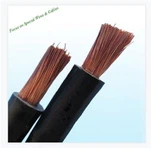
The outermost layer of the power cable is generally rubber or rubber composite sheath. The function of this layer is firstly to insulate, but also to protect the cable from damage.
Power cables are divided into high-voltage and low-voltage cables. If it is high-voltage, there will be a layer of resin-like filler inside, which serves as insulation. In high-voltage cables, this layer is the most important part of insulation. The low voltage does not have this layer, and then there will be something like a ribbon wrapped inside, which is to fix each core of the cable and fill the gap in the middle.
The shielding layer is divided into two cases. The shielding layer of the power cable has two functions: one is because the current passing through the power cable is relatively large, and a magnetic field will be generated around the current. In order not to affect other components, the shielding layer can be added The electromagnetic field is shielded in the cable; second, it can play a certain role in grounding protection. If the cable core is damaged, the leaked current can flow along the shielding layer like a grounding grid, which plays a role of safety protection.
Control cables are used in many places, especially the control cables of computer systems. The shielding layer here is used to shield external influences, because its own current is very weak, and it is very afraid of the influence of external electromagnetic fields.
The composition of the power cable should be: conductive core, insulating layer, protective layer. Detailed classification (not to mention high voltage and low voltage): conductive core, inner semiconducting layer, insulating layer, outer semiconducting layer, copper shielding, filler, inner lining, double steel belt protective layer, outer protective layer. These parts are composed! The above description is for the 10kV power cable.





 Skype: verdecable