


Today we will talk about the outer layer of the sheath material for wires and cables. Experienced professionals in this field, as well as procurement and design engineers, are certainly familiar with the names TPE and PVC. Who should we use, one claiming to be a rising star in environmental protection and the other claiming to be the king of cost-effectiveness?
Firstly, let's understand what they are.
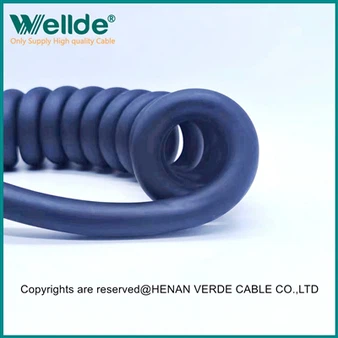
TPE as sheath material of cable or control cable,it is a thermoplastic elastomer, which can be imagined as an advanced and recyclable "rubber band". It is born with the elasticity and flexibility of rubber, has a good hand feel, and can be pulled back for a long time with a swoosh. The most crucial thing is that, like plastic, it melts when heated and can be repeatedly processed without the time-consuming and energy consuming process of "vulcanization" that traditional rubber must undergo. Common types include SEBS based ones, which have a smooth feel and good weather resistance.
And PVC as insulation or sheath material of electric cable, also known as polyvinyl chloride, is more like an oily a"rubber putty". Pure PVC is stiff and unusable. The soft PVC we use in our wires is softened by adding a large amount of "plasticizers" (such as common DOP). So its softness is "soaked" out. As for the performance, it all depends on what formula is added. It is cheap and naturally flame retardant, but it is prone to problems in terms of environmental protection and temperature resistance.

Just knowing what it is is is not enough. Next, let's compare their performance.
| Project Comparison | TPE material of Cable or control cable | PVC material of Cable or power control cable |
| Texture and elasticity |
Good elasticity, smooth or rubber like feel, quick rebound when pinched, not easily deformed. |
Strong plasticity, may have indentations over time, and sometimes feels sticky or rough to the touch. |
| Heat-resistant | Wide range, good ones can withstand temperatures ranging from -60 ℃ to 135 ℃, and remain soft in winter. | The range is relatively narrow, generally from -15 ℃ to 105 ℃. It becomes brittle when it is too cold and prone to hardening and aging when it is too hot. |
| Environment protection | Zero halogen, low smoke, non-toxic, burns like a candle, with less smoke and less odor. Does not contain harmful substances such as ortho benzene. | Chlorine containing, good flame retardant but toxic due to high smoke, with a pungent sour taste and black smoke when burned. Some plasticizers are not environmentally friendly. |
| Oil-resistant | Ordinary TPE is average, but special TPV is very oil resistant. | Poor resistance to mineral oil, gasoline, etc., prone to swelling and viscosity. |
| Machinability | Simple processing, no need for drying and vulcanization, fast extrusion, and full recycling of waste materials. | Be careful during processing, poor temperature control can lead to decomposition, corrosion of screws, and limited waste recycling times. |
| Density | Low density (around 0.9), same one meter, lighter material used. | High density (around 1.4), also one meter long, more pressing on the hand. |
Knowing their differences, how should we choose for cable or control cable?
Choose TPE for the following common situations
1. If your product is going to Europe and America or used as medical equipment, children's toys, or appliances that come into contact with food, it must be halogen-free and environmentally friendly
2. When used in cars (especially near the engine), outdoor equipment in winter, and cables for cold storage, that is, in situations where there is a temperature difference in the environment
3. In situations where wires are constantly moving, such as robots, drag chain cables, and frequently retracted coils that require repeated bending, TPE has good fatigue resistance
4.If pursuing requirements for delicate surface and comfortable touch, such as high-end headphone cables, data cables, high-end appliances, etc., TPE can also be chosen
The following situations can be considered PVC as the insulation or sheath of Power cable or control cable
1.If your budget is relatively low and you have a high demand for wires, you can consider PVC Cable.
2.If you have high requirements for flame retardancy or fixed installation, then PVC is a good choice, for example. In well ventilated pipes and cable trays.
3.If you have been using PVC for many years and have no objections and do not need to change the material, then you can still use PVC
The world of materials updates every day, but the underlying logic remains unchanged. I hope this comparison can become a practical guide at your fingertips. Choosing not only TPE or PVC cable, but also choosing a long-term partner.
Subscribe to my blog and I will continue to share valuable insights on cable materials, processes, and industry trends, hoping to help you avoid pitfalls and make accurate decisions.




 Skype: verdecable