


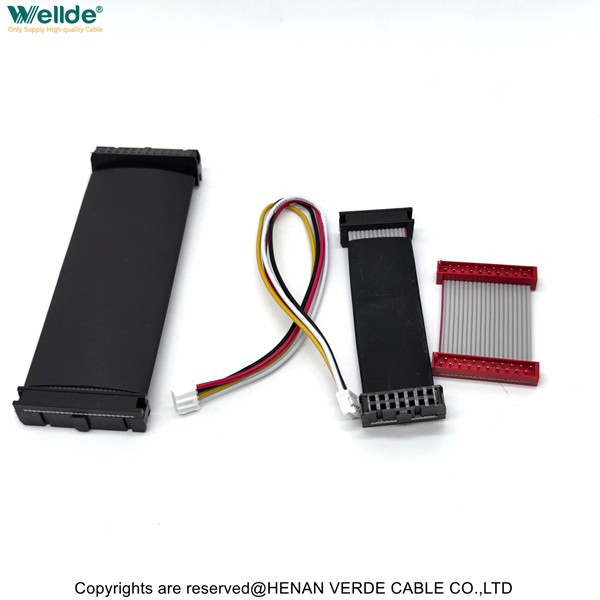
TVVB elevator flat cable is a mainstream category of elevator traveling cables, specifically designed for the vertical reciprocating operation of elevators. It is typically composed of conductors, insulation layers, shielding layers, sheaths, and other components, and possesses excellent flexibility, wear resistance, and anti-interference capabilities to meet the vertical operation requirements of elevators.
The main types of elevator cables are flat and flat-plate cables. Flat cables, commonly denoted as TVVB, are suitable for traveling cables, while flat-plate cables are used for video signal transmission and other applications. The rated voltage of elevator cables is generally 300/500V, with a test voltage of 2500V, and the operating temperature range is typically between -15℃ and 70℃.
Advantage
1. Suitable for scenarios where the elevator moves up and down repeatedly, the cable can bend frequently without deforming, the core wire is not prone to breaking, and it has strong durability
2. When the elevator is in operation, the cable will be subjected to natural pulling forces. The reinforced design of the outer skin and internal structure ensures that it will not be torn, thus affecting power supply
3. Flat cables have a relatively small bending radius, which allows them to be flexibly arranged in limited spaces.
4.The flat cable can not only be used as an elevator cable, but also for other functions, including electrical connections for control, lighting, air conditioning power, escalators, vertical conveyors, industrial elevators, and more.
Shortcoming
1. Flat cables are not designed for high-speed communication systems, so signal transmission experiences significant attenuation and may also suffer from mutual crosstalk
2. Most can only be bent along the flat surface. If bent perpendicular to the plane, it will be particularly strenuous and prone to damaging the cable structure. The bending direction is limited
Classification
|
Classification Basis |
Common Types |
Application Scenarios |
|
Functional purpose |
Power flat cable |
Transmit power loads for elevator car lighting, fans, air conditioning, etc |
|
Signal type flat cable |
Transmit signals such as call buttons, door machine control, and floor display |
|
|
Composite flat cable |
It includes both power cores and signal cores |
|
|
Shielding performance |
Unshielded |
Power transmission or low-frequency signal transmission in ordinary elevators |
|
Shielded |
Sensitive signal transmission such as video surveillance and variable frequency door machine control for high-end elevators |
Installation precautions
1. Bend naturally along the flat surface of the cable, and avoid hard bending or folding perpendicular to the flat surface to prevent direct damage to the internal core wires and external sheath, which could lead to cable cracking and transmission failure.
2. The up-and-down operation of the elevator will exert natural pulling force on the cable, so it is necessary to fix the cable in sections evenly and reserve appropriate movement allowance
3. Flat cables are not suitable for high-speed communication. If they are used to transmit control signals, they need to be arranged separately from strong electrical core wires to reduce signal crosstalk
4. Although the bending radius of the flat cable is small, sufficient space should still be reserved for its vertical movement and natural bending, without squeezing or pinching the flat cable



 Skype: verdecable