

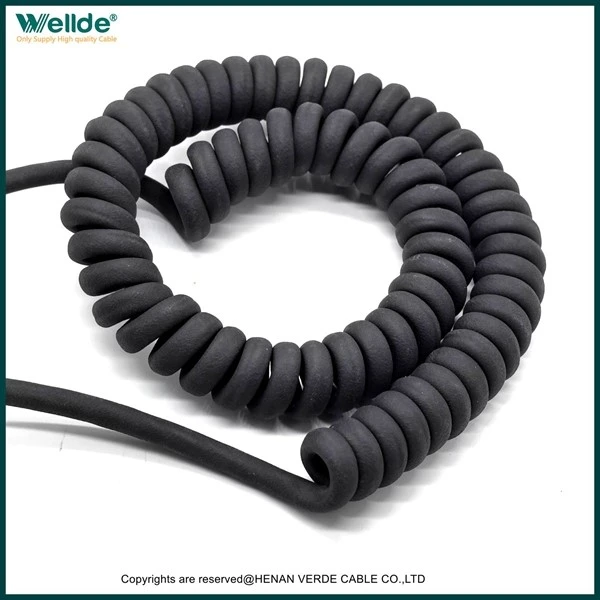
The two main types of outer skins for spiral cables on the market are PVC and PUR. There is a significant difference in their performance. Especially for equipment that needs to be repeatedly stretched and contracted every day, choosing the wrong material will double the cost in the long run. Let's clarify the differences between them. After reading this, you won't make mistakes when choosing.
1. Resilience Difference
PVC spring cable
PVC achieves softness through the use of plasticizers. After repeated stretching over a long period, the internal plasticizers gradually leach out and lose their effectiveness, resulting in decreasing elasticity. The retraction speed after stretching is very slow, and spring coils often fail to retract completely, the cable becomes loose and droops. After a certain period of use, the gaps between the coils increase, and the wiring becomes messy and tangled. The improved PVC performance will be significantly enhanced, and the raw material cost is more than 30% lower than PUR.
PUR polyurethane spring cable
PUR inherently has a high elastic molecular structure. Upon stretching and releasing, it automatically rebounds. The coils are tight and do not deform. It can be stretched up to 3-4 times its original length. After millions of expansion and contraction cycles, it still maintains stable rebound. Over a long period of use, the coils will not become loose or elongated and deformed. The wiring remains neat and orderly even when the equipment moves back and forth.
2. Wear Resistance and Tensile Life
The PVC outer skin material is brittle and has poor wear resistance. Even a slight friction with equipment or the ground can cause it to scratch and turn white. After frequent pulling and bending, fine cracks appear on the surface of the protective cover, which gradually extend inward and eventually wear through the insulation layer, exposing the copper wire and causing a short circuit. The standard test can only withstand tens of thousands of bends. With frequent use by automated equipment and handheld tools, the lifespan will be shorter.
The PUR outer skin is recognized in the industry as a highly wear-resistant material. Its wear resistance is 3-5 times that of PVC, and it has strong anti-tear and anti-scraping capabilities. It is not easily damaged by friction from crushed stones in the workshop, metal edges and corners, or dragging back and forth. It can withstand millions of repeated expansions and contractions. Under the same conditions, its service life is 2-3 times that of PVC cables, significantly reducing the labor and material costs for replacing cables.
3.Oil resistance and environmental adaptability
The shortcomings of PVC are prominent. It is not resistant to engine oil, cutting fluid, and lubricating oil. Long-term exposure to oil stains will cause the outer layer to swell, soften and become sticky, accelerating aging and cracking; in low-temperature environments (below -5℃), it will become hard and brittle directly; long-term outdoor exposure to sunlight is prone to aging and powdering, and it is only suitable for dry, normal-temperature, and oil-free indoor simple equipment.
PUR is fully adaptable to harsh working conditions. It is resistant to engine oil, coolant, and various weak acid and alkali solvents. Long-term use in an oil-stained workshop will not cause expansion and deterioration; the temperature range is -40℃ to 80℃. In northern low-temperature workshops and outdoor equipment, it remains soft in winter; it has built-in anti-ultraviolet performance, and is not prone to aging when used outdoors for a long time. It is also not prone to water cracking in damp and water-containing environments.
4. Comparison of low-temperature performance
PVC: After the temperature drops, its hardness significantly increases. In winter, repeated expansion and contraction is likely to cause the outer layer to crack.
PUR: It maintains softness and toughness at low temperatures. It will not crack even when bent or stretched at minus 30 to 40 degrees Celsius. It is recommended for use in refrigeration equipment and outdoor mobile devices in northern regions.
5. Cost and Adaptation to Scenarios
PVC spring cables are suitable for these scenarios
Indoor small equipment, with few stretching and contracting times per day, low-frequency usage;
Dry, dust-free, oil-free, and at room temperature environment;
Low-cost simple equipment, temporary connection lines, with low requirements for service life.
Advantages: Low unit price, cost-effective for short-term use.
PUR spring cable mandatory field
Industrial robotic arms, automated equipment, mobile sensors, handheld detection instruments, multiple times of reciprocating stretching per minute;
Machining equipment, welding equipment, construction machinery, workshops with a lot of oil stains;
Outdoor equipment, winter low-temperature environment, outdoor mobile lamps;
The equipment needs to operate stably for a long time and does not want to frequently replace cables or stop for maintenance.
Disadvantages: The purchase price is higher than PVC, but considering the overall service life and maintenance cost, it is more cost-effective.


 Skype: verdecable