


Ethernet cable is the core of modern wired network. Only selecting the appropriate network cable can ensure the stable and high-speed data transmission. We are a professional manufacturer of wires and cables. This guide will clarify the core parameters of the network cable, including conductor material, cable structure, shielding type, and actual application scenarios. We hope to help you choose a network cable scheme with high cost performance and reliable quality.
Conductor
Oxygen free copper: This is the best material with low resistance, high signal transmission efficiency and low loss.
Copper clad aluminum: the purpose is to reduce the cost. The core is aluminum and copper coating. Performance is not as good as pure copper, with higher resistance and significant signal attenuation over long distances.
Specification
Common specifications are 23AWG, 24AWG, and 26AWG.
Cross Separator
Made of rigid plastic, it physically separates the four twisted pairs to further reduce crosstalk and ensure signal quality during high-speed transmission.
Tensile Strength Member
Galvanized steel wire or fiber thread increases cable strength, preventing breakage during pulling. Not all Ethernet cables have it, but high-quality ones generally include it.
Insulation
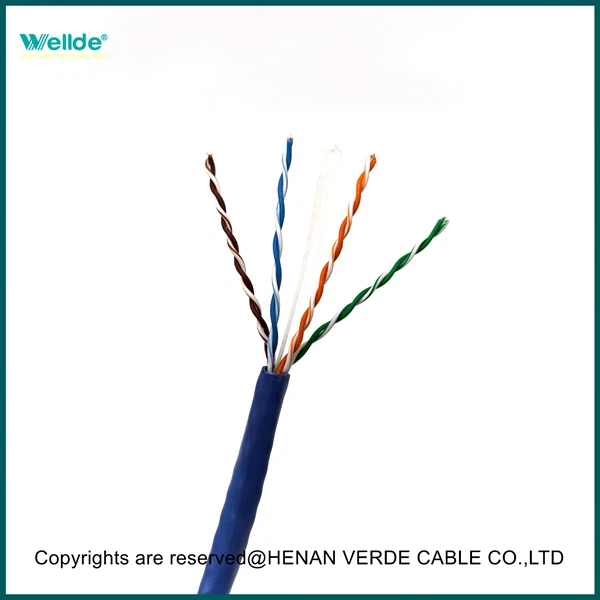
The insulation layer is typically PVC or PEThe standard configuration includes twisting them in pairs to form four pairs of "twisted pair". Each pair consists of insulated wires of different colors wound together (for example, orange white/orange, blue white/blue, green white/green, brown white/Brown).
Insulation Barrier Layer
A transparent plastic layer that further separates the four twisted pairs from the metal shielding, preventing additional interference from direct contact.
Shielding
Aluminum foil+metal woven mesh (or single aluminum foil) shield external electromagnetic interference.
Outer Jacket
PVC (Polyvinyl Chloride) or Low Smoke Zero Halogen material (LSZH is more environmentally friendly, has good flame retardancy, and is often used in high-end projects) to protect the internal structure, providing wear resistance, corrosion resistance, and tensile strength.
Voltage
Ethernet cables transmit low-voltage signals (typically below 12V, much lower than mains electricity), used for data signal transmission, not power transmission.
Usage Scenarios
Family: network socket wiring in living room and bedroom, connecting router and intelligent equipment (computer, TV, camera, etc.).
Office: network cabling between workstations, server rooms and servers to ensure high-speed connection of multiple devices.
Commercial/industrial: WiFi coverage in shopping centers, factory monitoring networks, data center server cluster interconnection, etc.
Categories
|
Category |
Label |
Bandwidth |
Max. Transmission Speed |
Key Features |
Application Scenarios |
|
Cat5 Cable |
Cat5 |
100MHz |
100Mbps |
Early basic version, no cross separator |
Old residential wiring, temporary offices, low-speed devices |
|
Cat5e Cable |
Cat5e |
100MHz |
1000Mbps |
Mainstream cost-effective, higher twist density |
Home renovation, general office, Gigabit router/computer connections |
|
Cat6 Cable |
Cat6 |
250MHz |
10Gbps |
Has cross separator, better anti-interference |
High-end homes, enterprise server rooms, 10GbE network cabling |
|
Cat6a Cable |
Cat6a |
500MHz |
10Gbps |
Shielded/Unshielded options, longer transmission distance (≤100m) |
Data centers, industrial workshops, long-distance high-speed transmission |
|
Cat7 Cable |
Cat7 |
600MHz |
40Gbps |
Double-shielded structure, full metal shielding |
Large data centers, high-end server clusters, industrial high-interference environments |
|
Cat8 Cable |
Cat8 |
2000MHz |
40Gbps/100Gbps |
Shielding stronger, thicker wire gauge |
Ultra-high-speed data centers, AI server rooms, future 5G/6G infrastructure |



 Skype: verdecable